Women in Parliament Statistics from around the Globe
23.4% of politicians in China are female.
Many other countries have surprisingly high rates of women in politics.
Rwanda leads the world, with 63.8% of politicians are female.
Andorra is #2, with exactly 50% of politicians are female.
Cuba is #3, with 48.9% of politicians are female.
Canada is #55 with 25.1%.
The UK is #64 with 22.6%.
The United States is tied with San Marino for #85, with 18.3%.
You can browse the detailed stats by visiting http://www.ipu.org/wmn-e/classif.htm
Keeping in mind there is only about 190 countries in the world, so the the USA is really in the middle - halfway, which means it is getting beaten by countries like the Czech Republic, Bosnia, Peru, Croatia, Vietnam...
So what countries is the USA beating in terms of women in politics?
The United Arab Emirates. Oh and the DPRK (aka, North Korea). So the USA is only slightly better than UAE (a country that uses bits and pieces of Sharia law, where women are still flogged or stoned in public) and only beating North Korea by 2%, a country so backwards and scary they could declare nuclear war at the drop of a pin.
http://en.wikipedia.org/wiki/Women_in_the_United_Arab_Emirates
http://en.wikipedia.org/wiki/Women_in_North_Korea
And to be fair, the UK and Canada isn't much better.
For example lets compare heads of state...
The United States has NEVER had a female president. Not once since 1776.
The UK had Margaret Thatcher (who was so conservative it defies belief), who was the first and only female PM in British history.
And then there is Canada's Kim Campbell - who didn't even win an election. She was placed in the PM's chair by Canadian Prime Minister Brian Mulroney, who was leaving politics. She was only in power from June 25th to November 4th 1993. Less than 5 months.
What this tells us is that the USA, the UK and Canada really has barely only scratched the surface when it comes to women's equality and women in politics.
It tells me that more women in these countries need to be entering politics. It tells me that women in these countries are being discouraged from entering politics, and that means their voices are not being heard because they are being shouted down by men who still think women belong in the kitchen.
Sorry guys.
Women belong in the House. And the Senate. And the Oval Office.
Get used to it.
Did Pussy Riot started a new wave of Feminism?
Hey Sandra!
A new wave of transnational feminism? No, I don't think that has been started.
Did you hear about this in the news?
"A 15-year-old girl in the Maldives who was allegedly raped by her stepfather has been sentenced to 100 lashes for having premarital sex.
Her stepfather hasn't faced trial for accusations he raped the teen and killed their baby, BBC reported.
The girl and her stepfather were charged in June 2012, Amnesty International stated, after the body of a baby was found outside their house on Feydhoo Island. The human rights group said the stepfather had allegedly sexually abused the girl for years.
Zaima Nasheed, a spokeswoman for the juvenile court, told BBC the girl was also placed under house arrest for eight months and defended the punishment saying the girl had willingly acted outside the law.
Under Maldivian law, the girl won't receive her punishment until she turns 18, Amnesty International said.
"Flogging is a violation of the absolute prohibition on torture and other cruel inhuman and degrading treatment or punishment," Amnesty International said prior to the sentencing.
The nation of islands is located southwest of Sri Lanka in the Indian Ocean."
If a new wave had started people would be more worried about things like that and try and stop it.
Now back to your question...
No, there is no "new wave". If anything its the old adage "two steps forward, three steps backwards". Now I am not saying we aren't making progress, we are making progress. But it is a very slow process.
And if we want to make radical / rapid progress then we need to start thinking outside the box and going for more radical thinking.
Which is funny because I don't consider myself to be a radical feminist. Or a militant one. But the older I get the more I wonder if there is radical / militant alternatives.
Take for example Japanese whalers. I think we should be ramming their ships and sinking them. Torpedoes if necessary. Then rescue the survivors. Make it clear that whaling as an industry has to stop and that whalers will be dealt with the same way we deal with pirates off the coast of Somalia - we kill them. If we are killing pirates for hijacking oil tankers, why aren't we killing whalers for killing whales?
Now I realize that is a controversial thought. But lets apply that same logic to rapists. 99% of the world's rapists are walking around free. Why? Because only 10% of women report sexual assaults to the police. A tiny percentage of them goes to court. And convictions are rare, even when there is physical evidence. So it really is no surprise so many rapists walk free.
Plus, even if we do convict them... we later release them years later, back in to society. And many sexual offenders are repeat offenders. So the only permanent solution is to remove them from normal society entirely - which is why I think we should build a penal colony on Greenland or some other remote island and send all of the world's rapists there. Yes, it is an unusual solution, but it would work.
So if you're looking for a new wave of international feminism then it should be happening in the courts and in politics first - and it will require some radical new laws to deal with people not fit to live with the rest of society.
And then there is the matter of conviction rates. James Holmes (the Batman cinema massacre) may be forced to take a truth serum during his trial. If we can do that for mass murderers, why can't we do that for rapists? We evidently have the technology to get the truth out of people using drugs, why aren't we using this technology to improve our justice system?
On the topic of Russia, the Pussy Riot case is evidently motivated by politics - the silencing of political enemies. It isn't so much that Pussy Riot is a feminist group. They're a political group, and the Russian government wants to silence them. But it backfired and now the media spotlight has hold of it.
Moscow releases 1 member of Pussy Riot
A Moscow appeals court on Wednesday unexpectedly freed one jailed member of punk band Pussy Riot, but upheld the two-year prison sentences for the two other women jailed for an irreverent protest against President Vladimir Putin.
All three women were convicted in August of hooliganism motivated by religious hatred, but the charge was trumped up by the Russian government because it was really aimed at the Russian president Vladimir Putin. The group's impromptu performance inside Moscow's main cathedral in February was political in nature and not an attack on religion.
The case has been condemned in the USA and Europe, where it has been seen as an illustration of Putin's intensifying crackdown on dissent after his return to the presidency after four years as prime minister.
The Moscow City Court ruled that Yekaterina Samutsevich's sentence should be suspended because she was thrown out of the cathedral by guards before she could remove her guitar from its case and take part in the performance.
"The punishment for an incomplete crime is much lighter than for a completed one," said Samutsevich's lawyer, Irina Khrunova. "She did not participate in the actions the court found constituted hooliganism."
Dressed in neon-coloured miniskirts and tights, with homemade balaclavas on their heads, the women performed a "punk prayer" asking Virgin Mary to save Russia from Putin as he headed into a March election that would hand him a third term.
"The idea of the protest was political, not religious," she said. "In this and in previous protests we acted against the current government of the president."
Rights groups were frustrated by the appeals court decision.
"To see these two women sent to a Russian penal colony for the crime of singing a song undercuts any claim that Putin and the Russian government have to democracy and freedom of expression," Suzanne Nossel, executive director of Amnesty International USA.
Tolokonnikova appealed to Russians for understanding:
"I don't consider myself guilty. But again I ask all those who are listening to me for the last time: I don't want people to be angry at me: Yes, I'm going to prison, but I don't want anyone to think that there is any hatred in me."
The court also refused the defence lawyers' request to take into consideration that Tolokonnikova and Alekhina both have a young child.
Topless Protester cuts down Cross in Kiev
By having a topless protester cutting down a cross with a chainsaw in the Russian city of Kiev.
FEMEN are demanding the church stop supporting the dictatorship of Vladimir Putin.
Meanwhile Putin and Putin supporters are passing new laws which inhibit free speech and allows the government to arrest dissidents.
FEMEN is actually an Ukrainian feminist group. They posted a video online showing a topless blond FEMEN protester wearing red shorts, with the words “Free Riot” scrawled across her chest and arms, cutting the cross with a chainsaw and then pulling it down using a rope pulled by two other activists, and then posing with her arms extended crucifix-style.
You can see the video and many other FEMEN videos at http://vimeo.com/user4967407
A lot of their videos utilize breast baring in an effort to get the attention of the media and have gained notoriety in both the Ukraine and other countries for their brazen acts.
“By this act, Femen is calling on all the healthy forces of our society to mercilessly cut out of our brains the rotten religious prejudices which dictatorships rely upon and which prevent the development of democracy and women’s freedom,” the activists are quoted as saying.
The activists warned Russian President (turned-dictator) Vladimir Putin and Patriarch Kirill of Moscow and All Russia that they would “turn the blade of our chainsaw” against those “responsible for the suffering of innocent women” if the Pussy Riot members are jailed.
Three Pussy Riot participants – Nadezhda Tolokonnikova, 22, Maria Alyokhina, 24, and Yekaterina Samutsevich, 30 – have been charged with hooliganism over their protest in Moscow’s Cathedral of Christ the Savior on February 26, during which they performed a musical “punk prayer” calling on the Virgin Mary to “drive Putin out.”
If it had been anyone else they were mocking they probably would have got a slap on the wrist. But because Putin is cracking down on dissidents the Russian government decided to send a message to protesters by jailing them.
The verdict in the controversial trial, which has been condemned by Russian and international rights groups, led to the Russian musicians ti being imprisoned for 2 years. A hefty sentence for a minor protest.
In December 2011, FEMEN activists staged a topless protest at the Cathedral of Christ the Saviour screaming "God Turn Tsar Out!" The protest followed parliamentary elections in Russia on December 4, which the opposition said were mared by mass fraud in favor of the pro-Kremlin United Russia party.
In July, a topless FEMEN activist attacked Patriarch Kirill during his visit to Ukraine. She ran up to the patriarch screaming "Get out" and tried to block his way as he was reportedly walking towards the press at Kiev Airport.
The Truth about Conservative Feminism
Well first that depends on how you define "Conservative Feminism"... it does seem like a bit of an oxymoron. How can someone be a Conservative and yet a Feminist?
Well, you see there is really a variety of different definitions of Conservative Feminism...
#1. Traditional Feminism... This implies feminists who are more prone to modesty and they don't want to upset the apple cart. So they're Conservative in the respect that they don't like to mess with the traditional routine, but they still believe in equality.
#2. Pro-Life Feminism... They believe in equality, but not in the right to choose an abortion. They can even be radical or anarchist in other ways, but for whatever reason (ie. religion) they don't believe in the right to choose an abortion.
#3. Phony Feminism... These are power hungry people (ie. Sarah Palin) who denounce feminism while simultaneously seeking the support of other women while promoting themselves as a Conservative Feminist (or even Anti-Feminist) icon. The example of Sarah Palin shows how this is sometimes done. Politicians lie and use whatever means at their disposal to garner votes.
#4. Insert Your Own Variation / Definition Here... :)
Now to get back to what the role of Conservative Feminism plays we have several options...
Option A) To enlighten Conservatives about feminist issues (and hopefully not muck it up).
Option B) To offset radical/anarchist feminism who are too extreme.
Option C) To annoy the **** out of Pro-Choice Feminists. Seriously, there is nothing more annoying than a Pro-Life Feminist arguing their (usually religious) reasons for why abortion should not even be a choice. (My retort to them: An Open Letter to the Anti-Abortionists.)
Option D) To serve as a vanguard against prostitution and pornography. Some semblance of decency in society has to be maintained.
Option E) To support the right of women to be homemakers if they opt not to choose a career path.
So while we may not like Conservative Feminists, they do provide a productive role in the post-feminist world we live in. People have a choice and they can make whatever choice they want, whether it be Madonna, Whore or a Duality of Both.
See Also
Conservative Feminist Views
Feminism Vs Pornography
Feminism and Anarchism
Where have all the feminists gone?
Feminism in the New Gender Order
What is Socialist Feminism?
150 years until equal representation
The Centre for Women and Democracy report says political parties are key to getting more women into town halls.
‘Representative Democracy? Women in the 2011 Local Government Elections in England’ examines the elections held in May 2011 and found:
1. There was a net increase across over 3,500 seats of just 20 women councillors.
2. At the present rate, it will be more than 150 years before there are equal numbers of men and women elected to English local councils.
3. There were 318 wards where all the main three party candidates were male, 14 times as many as the 22 wards where all candidates were female.
Nan Sloane, report author and Director of the Centre for Women and Democracy, says:
“Only 31 per cent of councillors are women, and this isn’t improving. If the annual increase in women councillors stays as it is – just 20 across the sample of 3,500 seats we looked at – it will be many generations before women have an equal voice in local decision-making. This is shocking, and goes against all the rhetoric that we hear so often about the need for more women in public life."
“Since over 90 per cent of councillors belong to one of the big three parties, their candidate recruitment processes are key. But we also think that it’s astonishing that nobody has responsibility for the diversity of democracy nationally, and we shall be taking steps to ask government, the Electoral Commission and elections officers to do this, both in terms of providing support for the identification and training of candidates through a Democracy Diversity Fund, and by monitoring who is standing for election in the first place."
“In a genuinely representative democracy women would not be regarded as an added extra. They’re 51 per cent of the population, they’re more likely to be both the users and the providers - as employees - of local services, and they pay equal taxes. It’s high time they were equally represented."
Anna Bird, Acting Chief Executive of the Fawcett Society says:
“Nearly a century on from winning the vote, women remain outsiders in the corridors of power. We are underrepresented in town halls across the country and in Westminster – where men outnumber women 4 to 1."
“This report should act as a wake-up call for those who think business as usual will deliver the step change in women’s representation we so urgently need. Wishing and hoping isn’t working, it’s time we took a new approach."
British Women Artists during WWII
Women at war: The female British artists who were written out of history
The job of portraying battle has, traditionally, been seen as a male preserve. But Arifa Akbar discovers that women war artists also played a crucial role.
April 8th 2011Images of war, rendered on canvas, have traditionally been presented to us in the most morbid forms: John Singer Sargent's chilling trench portrait of blinded troops in Gassed, Picasso's orgy of civil-war violence in Guernica, bloodied battlefields and frontlines from which artists capture live conflict as bombs whizz past them.
What is not so well documented is the women who work on war's hinterland, both as artists and as subjects. Few would be able to name a female counterpart to Sargent – it is assumed that a creative response to such violent destruction can only be delivered from a male perspective, a Siegfried Sassoon or a Rupert Brooke crouching in a foreign field.
Yet women have, since the turn of the 20th century, been interpreting and illustrating war, casting a fascinating light on the forgotten social, industrial and personal histories born from conflict which, while not as graphic as the front line, are invaluable in fleshing out a fuller picture of the human cost of war.
From the early 1900s, when it was indecent for women to be witnessing war from the brutality of the front, female artists produced their own images, many creating unofficial portraits surreptitiously as they worked in weapons factories, in hospital wards and in the ambulance vans of the First and Second World Wars, others in Belsen and at the trials at Nuremberg, and more recently, at the mass graves in Kosovo and the bombed borders of Iraq.
In an effort to bring these extraordinary, yet forgotten, artists to public attention, the Imperial War Museum in London is to stage a comprehensive exhibition on the subject of women as eye-witnesses, participants, commentators and officially commissioned recorders of war, entitled Women War Artists. The exhibition, opening tomorrow, will bring the work of those from the early 1900s alongside a contemporary wave of artists, including the Turner Prize shortlisted artist Fiona Banner, and the Palestinian video-artist, Mona Hatoum.
Kathleen Palmer, the show's curator, hopes the museum's survey will redress the enduring myth of the war-artist as an intrepid man dodging bullets, gun in one hand and sketchpad in the other.
"It's often misunderstood what the role of the war artist is," she says. "A lot of people think it is frontline sketching. War art encompasses far more than battle scenes or life at the frontline – it is about artists' creative responses to all aspects of war as seen and experienced by ordinary people, civilians, as well as servicemen and women. We look at women who find themselves in the war zone but also at those producing images unofficially, without the permission of the government in the First and Second World Wars, and also at women entering male workplaces in order to draw them, which was a radical thing to do then."
The first official war-artists' scheme was set up by the British government in 1916, mainly for propaganda purposes and for memorialising the nation's war effort. A host of artists were commissioned for this purpose, though only four women compared to 47 men, and of these four, three had their work rejected, while one did not take up the commission, so there was effectively no "official" female representation. However, the more determined artists, working independently and without government aegis, found themselves close to the frontline through medical work in hospitals and ambulance units, and began recording what they saw.
Olive Mudie-Cooke, already a trained artist who was driving ambulances for the British Red Cross in France from 1916, was one such woman. The images she produced departed from "official" fare: they featured hospital and auxiliary staff – images of the forgotten army of wartime helpers that would later be dramatised and in the novels of Pat Barker, and Sarah Waters's The Night Watch.
"Olive Mudie-Cooke served in France and Italy as an ambulance driver," says Palmer, "and she created work that responded to the situations she found – other women, the brands of tanks, landscapes, dramatic watercolours of nurses and ambulance staff lighting a cigarette, or ambulances being loaded with equipment."
At the start of the Second World War, women artists were given more leeway after the government's War Artists Advisory Committee (Waac) was set up, though there were still grave imbalances. More than 400 artists were involved – 52 of whom were women, the latter receiving fewer and shorter commissions, lower pay and far less publicity. Two women were given overseas commissions but only one, Evelyn Dunbar, was entrusted with a salaried position, and both were allowed to travel abroad only after the fighting had ended.
It was not until 1982, when Linda Kitson was commissioned by the Imperial War Museum to record the Falklands conflict, that a British female artist was sent overseas to accompany troops going into battle, although women were not permitted to stay overnight on naval vessels at the time so Kitson had to travel on the QE2.
In 1945, as victory in Europe looked likely, an artist called Mary Kessell was preparing to go to Germany. By the time she arrived, the war was over but she created memorably intense charcoal drawings of homeless women and children in Berlin, as well as the destruction of Hamburg. Kessell also produced images of the Belsen resettlement camp, home to refugees and displaced people including some ravaged survivors of Bergen-Belsen concentration camp a few miles away.
Another female artist to be given an overseas commission in the 1940s was Dame Laura Knight. At the time she was painting, women auxiliaries had become more common, although female involvement in combat was strictly prohibited. Corporal Daphne Pearson, a member of the Women's Auxiliary Air Force (Waaf), sat for a portrait by Knight and revealed in a letter to her mother that the artist originally painted her with a rifle. The final painting features her brandishing a respirator instead of the weapon. It is not clear whether Knight was instructed to modify the image to make it less shocking, or whether she decided to tone it down herself. Corporal Pearson wrote in 1940: "I am being painted in a tin helmet and holding a rifle – Air Min [Air Ministry] will be furious but Dame Laura says my helmet is rather like a bonnet on the back of my head and the rifle makes a good line – Waafs are 'not to carry arms' – controversy is still raging and this will upset the apple cart. Dame Laura is adamant and firm."Knight went on to become the first female artist since 1768 to become a full member of the Royal Academy. Her high standing enabled her to request an assignment to the International Military Tribunal at Nuremberg in 1945, which resulted in her painting The Nuremberg Trial. The tribunal tried 21 leading Nazis, headed by Hermann Goering. Knight was deeply disturbed by what she heard during the trial, and the realism of the courtroom in her painting is ruptured by the rubble of the city of Nuremberg shown as a ghostly backdrop.
"The trials just fired her imagination," says Palmer. "She drew many of the key Nazis in the dock. Unusually for her, it showed the back wall of the courtroom to have dissolved and the ruins of the city of Nuremberg lying there. She felt the destructive force of war needed to be in the painting."
The British Red Cross, meanwhile, commissioned Doris Zinkeisen to reflect their work in Europe in the 1940s, and she produced Human Laundry, a stark, searing image of the liberation of Bergen-Belsen concentration camp's starving survivors. Of her time there, she later said: "The shock of Belsen was never to be forgotten... The stable was used to wash any living creature down before sending them into hospital to be treated. Each stall had a table on which to lay the patient – the German prisoners did the washing. The church was used as a hospital for those that were alive.'" Despite her personal horror, Human Laundry is in some ways, a seminal work in women's war-art as it proved that women could unflinchingly present the most discomforting aspects of war.Social realities on the home front were also being presented more robustly the 1940s. Women with some artistic training were sneaking sketchpads into factories, without permission, depicting the civilian population contributing to the war effort, while others drew street scenes that captured air raids, shelters; sometimes these were comical or bittersweet images, at other times, shocking and violent. This work would have been considered dangerous and illicit had the authorities known about it, as imagery around war was tightly controlled for fear that it could used as negative propaganda.
Palmer says: "Women's images of the Blitz were hard-hitting. They were working independently, so doing more their own thing. Priscilla Thornycroft was an artist who was quite closely associated with the Communist Party, making drawings of places in Camden Town, people in the streets with air raids going on. They were dark and quirky and they really captured what was happening to individuals. Officially, the Blitz was reflected in a more abstract way but her work was specific about the working-class experience of war on the home front. It was quite a nice counterpoint to the official commissions." A previously unseen work by Thornycroft in the exhibition features a scene that took place early on in the Second World War when an air-raid warning frightened a bolting horse that became impaled on railings. She painted it in the 1950s in a lustrous style to highlight both the beauty and tragic outcome of the horse.
Margaret Abbess had completed her foundation course at the Royal College of Art but was conscripted and sent to make Spitfire parts in a factory before she could take her art training further: "She documented the factory work when she shouldn't have done. She didn't have permission but was covertly making sketches in her rest breaks and going home to work on the images. She was thinking of throwing them all away in 2005 when a family member told her to bring them to us," says Palmer.
The question of how female war-artists chose to represent ordinary working women during these decades is an interesting one. Images of women on the home front were not always "feminist" in the modern sense; some adopted the style of their older male counterparts while others painted women in stereotypically glamorised incarnations, even in factory scenes which, in reality, would have been sweaty places of industry.
The most iconic example of this glamorisation is an image of Ruby Loftus, a 21-year-old "shop girl" who mastered the difficult skill of screwing the breech ring of the anti-aircraft Bofors gun, a technique that normally took men almost a decade of dedicated experience. Her story was picked up by the Ministry of Information, which was trying to encourage women into weapons production at that point. Her portrait was painted by Knight and promptly exhibited at the Royal Academy.
Yet the image must have borne little resemblance to the reality of her work: "Ruby Loftus was painted in the middle of the mechanical process but in a way that reinforced the female stereotype. She was made to look very glamorous, wearing lipstick and with machinery that gleamed. It made her job look easy," says Palmer.
The image may have added to the conspiracy theories bubbling around that suggested Ruby Loftus was a fraudulent poster girl of the war, who could not, in fact, have been strong or clever enough to do the job.
More contemporary wars have led to different kinds of artwork: the rise of photo-journalism, and images delivered daily on our television screens from conflict regions, have progressively reduced the shock value of frontline artwork. War artists these days can be seen to be taking an "alternative" perspective, pioneered by female artists of earlier decades, that bring creative, personalised responses to war. Mona Hatoum, for example, renders hand-grenades as jewel-like coloured glass objects that encompass a terrible beauty in her piece, Nature morte aux grenades, while Rita Duffy transforms a weapon into confectionery in Dessert, which features a gun, cast from an AK-47 rifle that was decommissioned through the Northern Ireland peace process, but made out of chocolate.
The message in both these works appears to critique the fetishised status that the weaponry of war has assumed in contemporary culture.
"[Duffy's] piece embodies the attraction of violence, the temptation of the empowerment which comes from joining paramilitary organisations" and yet, "the gun is neutered: only made of chocolate, it cannot be used," comments Palmer.
The German artist Frauke Eigen, who photographed scenes from Kosovo in 2000 following its ethnic cleansing, has explained why she decided to photograph the personal effects from bodies exhumed from mass graves of genocide victims in Kosovo, rather than the bodies themselves.
"The sight of these bodies and the strong stench of formaldehyde made me leave the place, and on my way out I saw these clothes laying there in the sun for drying after they had been washed. For some reason, maybe because these clothes were much more human-like and recognisable than the bodies, I felt far more touched and disturbed and started to take pictures." Hatoum, similarly, has said she resists the demand for the literal horror of war.
"When I started making these works I was criticised for not showing the 'spectacle of horror' but expecting the viewer to imagine for themselves the impending disaster. I personally felt that this was precisely the strength of the work and a sign of maturity in the way the work conjures up certain images in the viewer's mind."
And in her sentiment, Hatoum sums up much of the spirit, imagination and force of a century of women war-artists.
Women War Artists, Imperial War Museum, London SE1 (020 7416 5320)9 April to 6 JanuaryThe art of war: women at the front
Dame Laura Knight RA (1877–1970)
Knight trained at the Nottingham School of Art and began by taking her subjects from the world of circus and ballet. These images were well received and established her as a leading artist of her generation. By the outbreak of the Second World War, Knight was the most important woman artist in Britain and the first to be elected a Royal Academician since 1768. Knight worked various commissions for the War Artists Advisory Committee and, at the end of the war, she was granted permission to paint the trial of major war criminals at Nuremberg. She spent the first months of 1946 in Germany, making her one of only three women war-artists commissioned to travel abroad to record the war.
Anna Airy (1882–1964)
Having trained at the Slade School of Fine Art, she was one of the first women to be officially commissioned. Invited by the Munitions Committee of the Imperial War Museum in 1918 to produce four pictures representing typical scenes in munitions factories – the shell forge at the National Projectile Factory in Hackney Marshes (London), a gun forge near Manchester, the aircraft assembly shop at Armstrong-Whitworth, Hendon, and the Singer factory in Glasgow. The conditions under which Airy worked were stringent and included penalties for any delay in her work. One painting, showing munitions girls leaving work, was produced at the request of the Ministry of Information's British War Memorials Committee in 1919. It was rejected by the Committee and later destroyed by the artist.
Margaret Abbess (1922–2008)
Abbess was offered a place at the Royal College of Art (RCA) but was conscripted into war work in 1942. Security was extremely tight in factories engaged in war production. Drawing sensitive subjects or places required a permit – which Abbess did not have. Nonetheless, while working in an aircraft components factory she produced several drawings of factory scenes. This work was produced in secret, often during breaks, and provides an unofficial insight into factory life. Most of Abbess's drawings began as small sketches which she later completed at home from memory. After the war, Abbess finished her studies at the RCA and worked for many years in art education. She kept her war drawings but felt they were of limited artistic value. In 2005 she considered destroying them, but was encouraged by her family to offer them to the Imperial War Museum.
Mona Hatoum (b. 1952)
Mona Hatoum was born in Lebanon to a Palestinian family. She studied in Beirut, moving to Britain in the 1970s. When civil war broke out in Lebanon in 1975 she found it impossible to return home, and settled in Britain, training at the Slade School of Art. Hatoum's early work often includes performance and video ("Measures of Distance", above). She uses domestic objects such as kitchen implements and cots, or medical objects, such as trolleys and wheelchairs, to imply a sense of threat or violence. Her artworks have incorporated blades and pulsing electric currents. She now lives and works in London and Berlin. Her work is exhibited internationally and held in museum collections around the world.
Linda Kitson (b. 1945)
Kitson studied at St Martins School of Art and the Royal College of Art, where she specialised in illustration. She then taught at Camberwell, Chelsea and the City and Guilds Art Schools. Her drawings that appeared in "The Times" won her the Falklands commission from the Artistic Records Committee of the Imperial War Museum. Kitson became the first official female war-artist to accompany troops into action during the Falklands conflict in 1982. She travelled on civilian ships requisitioned by the Navy, as women were not permitted on naval vessels at the time. The original intention was for Kitson to disembark at Ascension Island, but instead she stayed with the forces throughout the conflict. She eventually produced more than 400 drawings showing all aspects of the conflict, except the actual fighting, most of which occurred at night. Her drawings were often completed at speed in hostile conditions.
Frauke Eigen (b. 1969)
The German-born artist studied photography at the Royal College of Art in London, and it was while working as a photo-journalist that she made her first trip to Kosovo, in 2000. While there, she was told that a mass grave containing the bodies of genocide victims had just been uncovered nearby. Witnessing the recovery operation, Eigen decided to photograph the clothes and personal items of the dead, rather than the bodies themselves ("Fundstücke Kosovo", left). Eigen recently completed a photographic project in Afghanistan.
The World's 100 Most Powerful Women?
However this list is extremely Americentric. 70% of the women are Americans, quite a few of them are entertainers (ie. Does Lady Gaga really deserve the #7 spot? Or Katie Couric #22?)... And to be honest, most of them you probably have never even heard of because they're not that famous.
A lot of the non-American women are presidents, CEOs or First Ladies of their countries, with very few exceptions. One of them is just a presidential candidate in Brazil... so apparently just running for president in a country makes you one of the top 100 according to Forbes.
A few are supermodels or athletes. Seriously, how does that make them powerful? By selling lingerie or tennis raquets?
Its all utter nonsense.
So BOOOOOO to Forbes and their phoney baloney list. They are just like making lists apparently to fill space, satisfy their idiot readers and get attention. Boooo!
1
Michelle Obama
First Lady 46 United States
2
Irene Rosenfeld
Chief Executive, Kraft Foods 57 United States
3
Oprah Winfrey
Talk show host and media mogul 56 United States
4
Angela Merkel
Chancellor 56 Germany
5
Hillary Clinton
Secretary of State 62 United States
6
Indra Nooyi
Chief Executive, PepsiCo 54 United States
7
Lady Gaga
Singer and performance artist 24 United States
8
Gail Kelly
Chief Executive, Westpac 54 Australia
9
Beyonce Knowles
Singer, fashion designer 29 United States
10
Ellen DeGeneres
Talk show host 52 United States
11
Nancy Pelosi
Speaker of the House 70 United States
12
Angela Braly
Chief Executive, Wellpoint 49 United States
13
Janet Napolitano
Secretary, Homeland Security 52 United States
14
Cynthia Carroll
Chief Executive, Anglo American 53 United States
15
Sheila Bair
Chair, Federal Deposit Insurance Corporation 56 United States
16
Sarah Palin
Political maverick and commentator 46 United States
17
Mary Schapiro
Chair, Securities and Exchange Commission 55 United States
18
Ellen Kullman
Chief Executive, DuPont 54 United States
19
Sonia Sotomayor
Supreme Court Justice 56 United States
20
Ursula Burns
Chief Executive, Xerox 51 United States
21
Angelina Jolie
Actor and UN Goodwill Ambassador 35 United States
22
Katie Couric
News anchor 53 United States
23
Kathleen Sebelius
Secretary, Health & Human Services 62 United States
24
Anne Lauvergeon
Chief Executive, Areva 51 France
25
Elena Kagan
Supreme Court Justice 50 United States
26
Patricia Woertz
Chief Executive, Archer Daniels Midland Co. 57 United States
27
Melinda Gates
Co-chair, Bill & Melinda Gates Foundation 46 United States
28
Arianna Huffington
Founder and editor-in-chief, Huffington Post 60 United States
29
Madonna
Singer, fashion designer 52 United States
30
Ho Ching
Chief Executive, Temasek Holdings 57 Singapore
31
Ruth Bader Ginsburg
Supreme Court Justice 77 United States
32
Maria Ramos
Chief Executive, Absa Group Banks 51 South Africa
33
Chelsea Handler
Talk show host and author 35 United States
34
Tina Brown
Cofounder and editor-in-chief, The Daily Beast 56 United States
35
Carla Bruni-Sarkozy
First Lady 42 France
36
Lynn Laverty Elsenhans
Chief Executive, Sunoco 54 United States
37
Elizabeth Warren
Assistant to the President and Special Adviser to the Secretary of Treasury 61 United States
38
Ana Patricia Botin
Chair, Banesto bank 49 Spain
39
Heidi Klum
Model and producer 37 United States
40
Meredith Vieira
Co-anchor 56 United States
41
Queen Elizabeth II
Monarch 84 United Kingdom
42
Carol Bartz
Chief Executive, Yahoo! 62 United States
43
Christine Lagarde
Finance Minister 54 France
44
Sallie Krawcheck
President, Global Wealth & Investment Management, Bank of America 45 United States
45
Sarah Jessica Parker
Actor and fashion designer 45 United States
46
Diane Sawyer
News anchor 64 United States
47
Meg Whitman
Gubernatorial candidate, California 54 United States
48
Marina Berlusconi
Chair, Mondadori and Fininvest Group 44 Italy
49
Stephenie Meyer
Author 36 United States
50
Rachel Maddow
Talk show host 37 United States
51
Carly Fiorina
Senatorial candidate, California 56 United States
52
Guler Sabanci
Chair, Sabanci Holding 54 Turkey
53
Maria Shriver
First Lady, California 54 United States
54
Carol Meyrowitz
Chief Executive, TJX companies 56 United States
55
Serena Williams
Athlete 28 United States
56
Anna Wintour
Editor-in-Chief, Vogue 60 United States
57
Andrea Jung
Chief Executive, Avon Products 52 United States
58
Julia Gillard
Prime Minister 48 Australia
59
Abigail Johnson
President, Fidelity Personal, Workplace and Institutional Services 48 United States
60
Venus Williams
Athlete 30 United States
61
Suze Orman
Author and personal finance guru 59 United States
62
Tarja Halonen
President 66 Finland
63
Marjorie Scardino
Chief Executive, Pearson PLC 63 United States
64
Mary McAleese
President 59 Ireland
65
Annika Falkengren
Chief Executive, SEB 48 Sweden
66
Sheryl Sandberg
Chief Operating Officer, Facebook 41 United States
67
Cathleen Black
Chair, Hearst Magazines 66 United States
68
Cristina Fernandez
President 57 Argentina
69
Anne Sweeney
Co-chair, Disney Media Networks 52 United States
70
Sheikha Lubna Al Qasimi
Minister of Economy 51 United Arab Emirates
71
Chua Sock Koong
Group Chief Executive, Singapore Telecommunications 51 Singapore
72
Gisele Bundchen
Model and fashion designer 30 Brazil
73
Christiane Amanpour
Anchor 52 United States
74
Sheikha Mozah Bint Nasser Al-Missned
First Lady 50 Qatar
75
Susan Ivey
Chief Executive, Reynolds American 51 United States
76
Queen Rania Al Abdullah
Monarch 40 Jordan
77
Nancy McKinstry
Chief Executive, Wolters Kluwer 51 United States
78
Rachael Ray
Talks show host and author 42 United States
79
Nikki Finke
Founder and blogger, Deadline Hollywood Daily 56 United States
80
Johanna Sigurdardottir
President 67 Iceland
81
Jing Ulrich
Managing director and chair, China Equities and Commodities, J.P. Morgan Chase 43 United States
82
Laura Sen
Chief Executive, BJ's Wholesale Club 54 United States
83
Laura Chinchilla
President 51 Costa Rica
84
Mary Callahan Erdoes
Chief Executive, Asset Management, JP Morgan Chase 43 United States
85
Janet L. Robinson
Chief Executive and President 60 United States
86
Ellen Johnson-Sirleaf
President 71 Liberia
87
Amy Pascal
Co-Chair, Sony Pictures Entertainment 52 United States
88
Tory Burch
Fashion designer 44 United States
89
Shikha Sharma
Chief Executive, Axis Bank 49 India
90
Sun Yafang
Chair, Huawei Technologies 54 China
91
Vera Wang
Fashion designer 61 United States
92
Chanda Kocchar
Chief Executive, ICICI Bank 48 India
93
Danica Patrick
Race car driver 28 United States
94
Maha Al-Ghunaim
Cofounder and chair, Global Investment House 50 Kuwait
95
Dilma Rousseff
Presidential candidate 62 Brazil
96
Donna Karan
Fashion designer 61 United States
97
Angela Ahrendts
Chief Executive, Burberry Group 50 United States
98
Ellen Alemany
Chief Executive, Citizens Financial Group 54 United States
99
Martha Stewart
Lifestyle Guru 69 United States
100
Dominique Senequier
Chief Executive, AXA Private Equity 57 France
Leslie J. Sacks' Ten Commandments
"In these uncertain and consequential times, I humbly suggest that we put aside our penchant for iPods and immediate gratification and consider my 10 new commandments [below]." - Leslie J. Sacks, L.A. California.
1) Men should learn to think more with their brains and not their genitals.
2) Women should focus more on their intellects and temper their hearts.
3) Never use violence and intolerance except to defend liberty.
4) Morality exists only in behavior and actions. Preaching morality doesn't make it so.
5) Women are ALWAYS equal.
6) Freedom and democracy are both rights and irrevocable responsibilities that must be protected.
7) Each individual has the inalienable right to their political and religious beliefs.
8) No institution or belief should take precedence over any one person.
9) No path to happiness is exclusive or worthy of domination over any other.
10) People who seek to dominate, control, subvert or destroy the freedom of other people do not deserve the respect of the free world.
The Truth about Eileen Nearne, aka Agent Rose
What had seemed an old woman destined for a pauper's grave is now being hailed as a British national hero. With no known relatives authorities searched her apartment looking for evidence of family... Amongst the things she left behind they found a treasure trove of medals and documents which referred to her as "Agent Rose", a wireless operator during Germany-occupied France and a member of the secretive Special Operations Executive (SOE).At the age of 23 the brave young Nearne had flown into France under the cover of darkness in March 1944 to work as an undercover agent helping coordinate resistance fighters and spies.
She was arrested by the Gestapo in July but thanks to her fluent French was able to hide her British identity. Her family had lived in France during her childhood. She was arrested again weeks later and imprisoned at Ravensbrueck concentration, then transferred to a forced labour camp in Silesia. She and two French girls escaped the camp in April 1945 but were caught days later.
She was later released when Nearne convinced their captors of their innocence, claiming they had only joined the French Resistance because it was exciting.
After WWII ended, Nearne was awarded with a membership in the Order of the British Empire in recognition of her services. She lived most of her life with her sister Jacqueline, who had also served in the SOE.
The Royal British Legion has taken over the funeral preparations, scheduled next week. (Personal Note: I am planning to attend the funeral myself, if the general public is allowed in.)On Tuesday a relative of Nearne was found living abroad, a niece who says she visited her aunt regularly and “she was always cherished by the family.” She added her aunt wanted her ashes to be scattered at sea.
Eileen Nearne’s story is well remembered by historians, including M.R.D. Foot in his popular book about the SOE in France (SOE, The Special Operations Executive 1940-1946, published in 1984) who writes:
"Eileen Nearne of WIZARD, who had transmitted a good deal of economic and military intelligence besides helping in the routine work of arranging drops for SPIRITUALIST, was caught at her set in July. She brought off a dextrous bluff, and persuaded the Gestapo she was only a foolish little shopgirl who had taken up resistance work because it was exciting; they never discovered she was half English. But they took her away to Germany all the same."
Later in the book, Foot recounts Eileen Nearne’s amazing escape from a Ravensbrück working party in April 1945. There are at least five other references to Nearne in the book. Foot’s book is not obscure either. Its quite popular. Eileen Nearne also apparently appears in Marcus Binney’s popular book "The Women Who Lived for Danger".
So Eileen Nearne's, aka Agent Rose's, story will be remembered by many.
The Truth about Women Terrorists in Chechnya
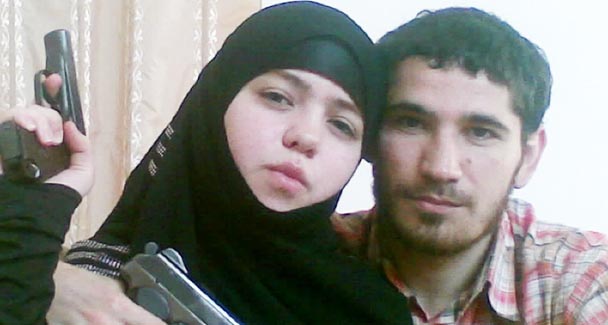
Videos and photos released by Chechen rebels have confirmed this.The trick about Chechen rebels is there is a duality about the situation. #1. Not all Chechen rebels are Muslim. There are also Christian and secular Chechen rebels. #2. Their primary focus is their fight to form their own government. They're not worried about creating a "Islamic State", they just want an independent Chechnya free of Russian rule.
The Russian government however is refusing to grand Chechnya independence (which was declared independent in 1991) because of oil pipelines that run through the region and thus instead has chosen to retaliate against Chechen rebels.
For the women involved there isn't a lot of opportunity to do anything else. Russian government programs in the region to promote education for women are almost non-existent, as such women seeking a career really have two choices: Motherhood or Martyrdom.And when your husband gets killed by the hate Russians the depression sets in. Do you get remarried when no husband will want you since you're "damaged goods"? Or do you go out with a bang?
For un-educated women from Chechnya they're barely even citizens under Russian law. The Chechen people have been relegated to 2nd class citizens and Chechen women? Pfff. They're basically 3rd class citizens. So its really not much of a surprise the people of Chechnya want their independence.HOWEVER this doesn't excuse their behaviour and attacking innocent people. The recent bombings in Moscow killed 39 people. There are other ways to PROTEST PEACEFULLY, but that is not the way of the Black Widows.

Its not just uneducated women or widows who join the cause of the Black Widows. Its women who just plain loved their country and want an independent Chechnya. Asides from the clothes they still enjoy spending time with friends, partying and doing other things popular with young people.
“It wasn’t an easy decision to go and fight,” says Rosa, cradling a Kalashnikov rifle on her lap and sitting under an apricot tree. “But when my friends told me my nursing skills were needed, I went. Then I found out that everybody had to take up the gun.”
Rosa is a seasoned fighter, battling Russian troops for Chechen independence for over a year now. She says the hardest thing was getting used to the uniform. “At first, when the commander told me to put on fatigues I couldn’t do it. Then I obeyed him, but put a skirt over the trousers.”Rosa is a member of the Black Widows. Not all of them are suicide bombers, some are simply fighters in a campaign of warfare that dates back before the 1991 declaration of independence. Since then the Black Widows has been responsible for over half the suicide attacks in Russia.
“Chechen women are the most dangerous for national security because they have carried out the most risky operations,” says a study by psychologists Anne Speckhard and Khapta Adhmedova. Women are able to get past Russian troops without being suspected and thus carry bundles of explosives with them for the purposes of eventually staging terrorist attacks.
History is filled with other examples of "Black Widows":
Yael, a nomadic woman, hammered a spike through the head of the sleeping Canaanite commander Sisera after he had fled a battle with the Israelites.
Jewish heroine Judith used her wiles to seduce and behead the drunken Assyrian general Holofernes and save her city of Bethulia.
Celtic Queen Boudicca fought the Romans after the death of her husband, fitting her chariots with knives to slash enemy troops.
Charlotte Corday stabbed Jean-Paul Marat in his bath, thus killing one of the instigators of the Terror during the French Revolution.
Fanni Kaplan, a Russian, shot Vladimir Lenin twice (he survived) because he became corrupt and betrayed her Socialist ideals.
Violet Gibson, the Irish aristocrat, made an unexplained assassination attempt on Benito Mussolini.
Valerie Solanas, 1960s manhater who founded the Society for Cutting Up Men, shot and wounded artist Andy Warhol.
Ulrike Meinhof, German anarchist, was involved in bombings, robberies and gunfights before killing herself in a jail cell.
Women however are still a minority in the history of killers, regardless of their motive. 700 years of homicide data shows male-on-male killings are 40 times more common than female-on-female killings. (Not including wars.)
“There is no known society where the level of lethal violence among women even approaches that of men,” says a study by Canadian psychologists Martin Daly and Margo Wilson. Male murderousness is driven by violent environments, bad childhoods and high testosterone levels that promote aggressive behaviour.
The Sri Lankan Tamil Tigers pioneered female suicide squads in the 1980s. Palestinian, Lebanese and Kurdish women followed suit.
Studies of Palestinian women bombers pointed to two main causes (according to a report from the Israeli-based Center for Special Studies):
#1. The vengeance for deaths of relatives.
#2. Being pushed into the fringes of society where they are made psychologically vulnerable.
Speckhard and Akhmedova’s 2006 study of Chechnya's Black Widows (based on 45 interviews with family members, friends or former hostages of 34 female suicide bombers) has some interesting results: “Nearly all had lost close family members in air raids, bombings, landmines, so-called ‘cleansing’ operations carried out by Russian forces, and in battle.”
When the Russian military is involved in ethnic cleansing its no small surprise the people of Chechnya have resorted to terrorism. Combined with high unemployment rates and low education it doesn't give people a lot of options.
The Truth about Feminism in the United States
American women are getting "bitch slapped" back down where 'they belong' on a regular basis in the United States. For all their beliefs about equality Americans still can't accept women as leaders or equals.
The Oklahoma legislature recently approved a move that would compel doctors to fill out 10-page forms on each abortion they perform, including questions about the woman's relationship with the "sperminator"... worse, all these details would then be posted on a public website.The idea is being pushed by the religious right-wing in an effort to discourage women from having abortions by fear-mongering them and exposing them publicly.
This is just one example of how women's rights are under attack.
If you read Maria Shriver's report "A Woman's Nation Changes Everything" or "When Everything Changed: The Amazing Journey of American Women from 1960 to the Present" by Gail Collins you will get a better idea of just how much women's rights is under attack by the religious right-wing.
Gail Collins' book has lots of little stories like the woman who couldn't get a lease unless it was signed by her institutionalized mental patient husband or the woman who was shouted out of traffic court by the judge for wearing slacks instead of a skirt.Collins also writes "Back then, if you wanted a career that involved travel, you'd have to have become a flight attendant..."
"Coffee, tea ... or me?"
The Great Pink North (Canada) meanwhile has free health care and maternity leaves, greater numbers in the workforce and halls of academia, but Canadian women still fall behind in government jobs and executive positions compared to the USA. So we're not much better if you we are realistic about it.
There's also the wage gap, both for wages and pensions. Women in particular suffer in their old age after their husband dies (or leaves in divorce) because they have little or no access to their husband's pension despite serving as homemaker and mother for decades.Worse, feminism has been so attacked over the years by men and the religious right-wing that young women now associate the F-word with hairy-legs and man-hating Feminazis. So regardless of whether you live in the USA or Canada, the truth is feminism has yet to be accepted as what it really is: Equality.
"Feminism needs to rebrand." - Cristina Simonetto, ad copywriter.
Feminist killed in Afghanistan
A Taliban spokesman, Qari Yousef Ahmedi, claimed responsibility for the attack.Four men drove up on two motorcycles and shot Sitara Achakzai as she was getting out of her car, just outside her home in Kandahar city and then rode off.
Sitara Achakzai, a dual German-Afghan citizen, spent the years of Taliban rule in Germany and returned to her native country to fight for women's rights, says Shahida Bibi, who worked with Achakzai as a member of the Kandahar women's association.
A member of Kandahar's provincial council, Achakzai was vocal in encouraging women to take jobs and encouraging them to fight for equal rights. According to relatives she also has a 99-year-old mother and sister living in Markham Canada.
The Truth about Affirmative Action
But first, lets stop and ask what is affirmative action?Affirmative action is about taking sex, race and ethnicity into account when giving people jobs. So for women in politics, affirmative action is hiring/electing more women for high and low ranking positions, so that the sex distribution is eventually roughly 50/50.
The point of affirmative action is to address social disadvantages so that equality is endorsed in the hopes that eventually people hire equal or proportional numbers of staff from different backgrounds.
But is affirmative action a good thing?Lets say for example I have a job available for an assistant manager. I want someone with experience and don't want to promote someone within the company because none of them have the relevant skills/experience.
I narrow down the resumes to 4 candidates, one Caucasian female, one Caucasian male, one ethnic minority female and one ethnic minority male. They're all roughly the same so I have decide whom to hire which one is best suited for the company. Depending on the current ethnic/sex makeup of the company I could pick any which one of them. In theory if we have a shortage of white males (fat chance that will ever happen) I should hire him. Depending on the company however it is possible.
Typically the ethnic minority female should be the one hired, but if the company already has plenty of ethnic minority females maybe the Caucasian female or the ethnic minority male would be a better choice. Its all about balance and can sometimes be a difficult challenge.
If all else fails, stick their names in a hat and pick one randomly.So affirmative action is usually good for women and minorities.
But what about the company? Does the company somehow benefit?
According to a new report from the Fawcett Society in the UK, yes they do.
Companies who hire equal numbers of women develop higher productivity, more profits and are more resistant to corruption and bankruptcy during times of recession. The report also discusses how women in the UK are currently dealing with the American recession and gives several possible solutions for addressing the inequality of women's pay and the lack of affirmative action in the UK.
One of the ideas is to fill government imposed quotas, similar to what Norway has done and has achieved remarkable success with.
In Norway, women's representation in boardrooms has soared from 6% to 44% since they first introduced quotas. The rule in Norway states that either gender may not exceed 60% of the workforce in public owned companies (ie. government buildings, utilities, etc). By enforcing this in public companies women get more experience, better resumes and this follows over into privately owned companies as those women take new positions later in life.
As a result of the changes Norway has seen a blossoming of its productivity in the workforce, with men and women realizing that if they want that promotion they're not just competing with the other men or the other women, but all the people... so if they really want that promotion they need to work harder.
The report's five point plan includes:
1. Promote women’s rights and stamp out discrimination.
2. Deliver a bold package to end pay discrimination.
3. Promote flexible working as a solution to the recession.
4. Fast-track women into decision making positions using quotas.
5. Ensure women’s skills are harnessed through education.
The real trick, for most industries, is that affirmative action is largely optional. Some industries just plain have a shortage of women who have studied that particular field (ie. engineering or physics).
But that could be addressed through university quotas, allowing in more female applicants wanting to study physics, engineering, etc.OR, depending on the field of study, it could be addressed by getting rid of class size caps, allowing more of both women and men into the program.
The point I am making is that affirmative action can be used smartly, and actually benefits companies in terms of productivity/profits.
See Also:
Women during Recessions
Jobs for Girls and Women
The Truth about Women's Work
Are High Heels a Detriment or a Benefit?
Male Hysteria at Work
Canadian Conservatives Eroding Women's Rights
For example, lets take the Conservatives' new "Equitable Compensation Act".
It has NOTHING to do with equal pay.
In fact, it's the opposite. It removes any chance women in the federal civil service have of fighting for pay equity by denying them the right to complain to the Human Rights Commission, or to go to court, when they believe there is discrimination. Instead, pay equity issues are to be solved as part of the regular bargaining process but - get this! - if anyone (including unions) agitates on the basis of pay equity, they face a $50,000 fine.
Ergo the Conservative Party is forbidding a woman from fighting for herself and, simultaneously, penalizing her union $50,000 from fighting for her.
Once this proposed legislation is passed, a woman working in the federal public service will have fewer rights than women working elsewhere in Canada.
This is nothing new either. Prime Minister Stephen Harper began attacking pay equity for women years ago when he was director of the right-wing National Citizens Coalition. He has been dead opposed to women receiving equal pay for equal work for as long as he's been in politics.
And what is even sadder is that the Liberals and NDP are quite powerless to stop this new Act because it was part of the recent February 3rd budget, which has already been passed and is now being tweaked, which the Liberal Party supported so that Canada didn't go to a new election. There has been a tiny bit of fuss about the new "Equitable Compensation Act"... but otherwise it has been largely ignored.
WAKE UP WOMEN OF CANADA! YOUR RIGHTS ARE BEING TAKEN AWAY!
Obama ends abortion-linked ban
FEMINISM/POLITICS - President Barack Obama on Friday struck down the Bush administration's ban on giving federal money to international groups that perform abortions or provide abortion information – an inflammatory policy that has bounced in and out of law for the past quarter-century.Obama's executive order, the latest in an aggressive first week reversing contentious policies of the previous president was warmly welcomed by liberal groups and denounced by abortion rights foes.
The ban has been a political football between Democratic and Republican administrations since Republican President Ronald Reagan first adopted it 1984. Democrat Bill Clinton ended the ban in 1993, but Republican George W. Bush re-instituted it in 2001 as one of his first acts in office.
"For too long, international family planning assistance has been used as a political wedge issue, the subject of a back and forth debate that has served only to divide us," Obama said in a statement released from the White House. "I have no desire to continue this stale and fruitless debate."He said the ban was unnecessarily broad and undermined family planning in developing countries.
"In the coming weeks, my administration will initiate a fresh conversation on family planning, working to find areas of common ground to best meet the needs of women and families at home and around the world," said President Obama.
Obama signed the executive order, without coverage by the media, late on Friday afternoon. The abortion measure is a highly emotional one for many people, and the quiet signing was in contrast to the televised coverage of Obama's Wednesday announcement on ethics rules and Thursday signing of orders on closing the Guantanamo Bay prison camp and banning torture in the questioning of terror suspectsHis action came one day after the 36th anniversary of the landmark Supreme Court ruling in Roe vs. Wade that legalized abortion.
The Bush Administration had banned money from going to international family planning groups that either offer abortions or provide information, counseling or referrals about abortion as a family planning method.
Critics have long held that the rule unfairly discriminates against the world's poor by denying U.S. aid to groups that may be involved in abortion but also work on other aspects of reproductive health care and HIV/AIDS, leading to the closure of free and low-cost rural clinics.Supporters of the ban say that the United States still provides millions of dollars in family planning assistance around the world. The ban has been known as the "Mexico City policy" for the city a U.S. delegation first announced it at a UN International Conference on Population.
Organizations and legislators that had pressed Obama to rescind the Mexico City policy were jubilant. House Speaker Nancy Pelosi (D-Calif.) said the move "will help save lives and empower the poorest women and families to improve their quality of life and their future."
Both Obama and Secretary of State Hillary Rodham Clinton, who will oversee foreign aid, had promised to do away with the rule during the presidential campaign. Clinton visited the U.S. Agency for International Development earlier Friday but made no mention of the step, which had not yet been announced.Anti-abortionists condemned Obama's decision.
See Also:
International Women's Day
Criminalizing Women